
If a tree falls in a forest and no one is around to hear it, does it make a sound? Philosophical musings aside, the answer is very plain: a falling tree produces a sound wave, regardless of whether there's an ear to hear it. But if that unfortunate tree happens to be in a remote forested region that is not covered by cellular networks, it may as well be silent because we’ll never know about it.
That is a bigger problem than it may seem. The health of forests is crucial for the global ecosystem, regulating climate, providing habitats for countless species, and supplying essential resources. However, monitoring these remote areas is incredibly difficult and expensive due to their vastness and lack of connectivity. The inability to get real-time data about events like illegal logging, wildfires, or disease outbreaks in these unconnected areas means that preventative measures or rapid responses are often delayed or impossible.
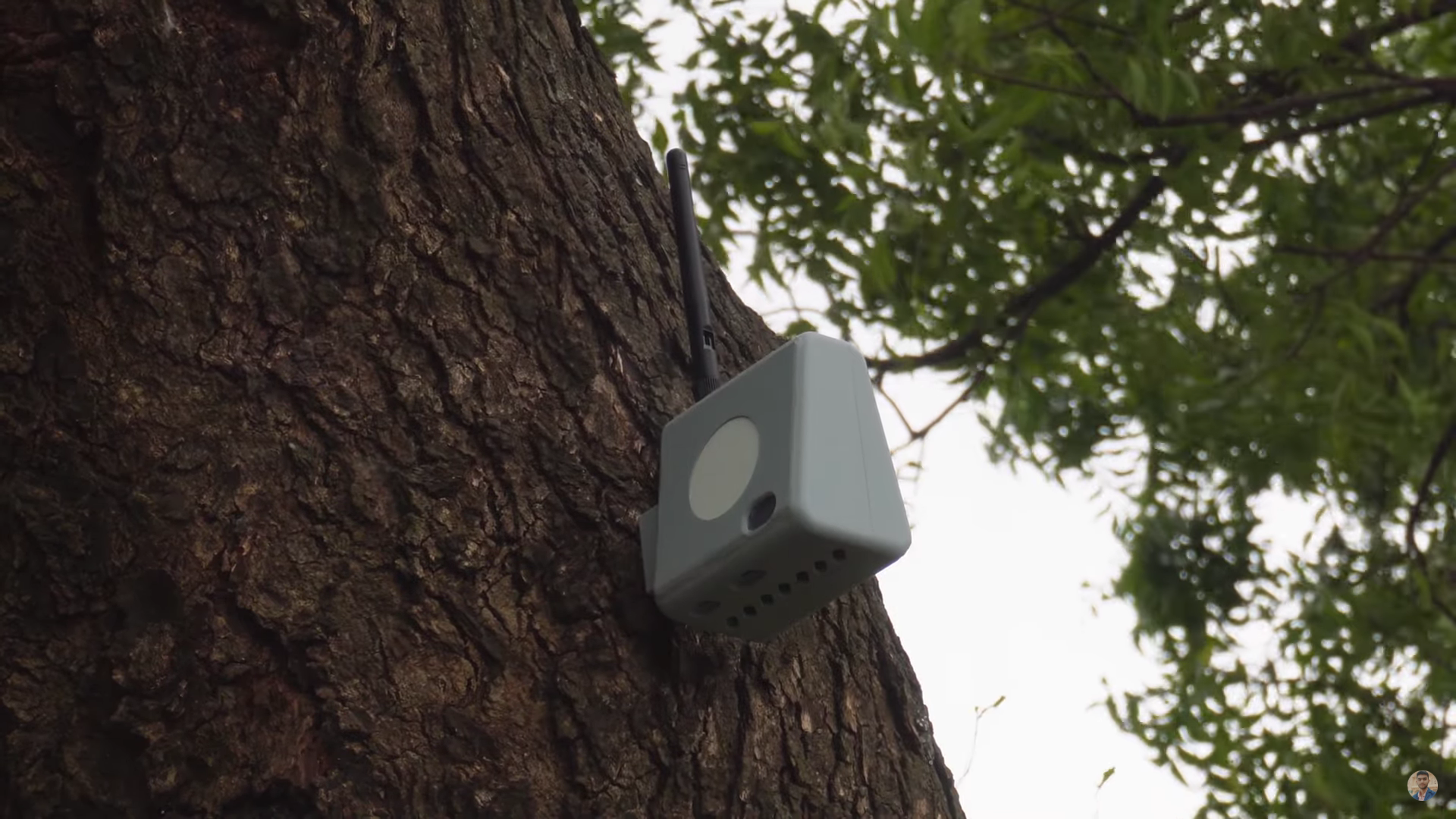
Engineer Mukesh Sankhla doesn’t think that problems like this should still exist in today’s world. He believes that the technology required for practical forest monitoring systems already exists — we just have to be more creative about how we use what we’ve got. To demonstrate how we might be able to inexpensively detect everything from illegal logging to poaching in remote areas, Sankhla created what he calls Forest Guard. It is a decentralized, edge AI-powered LoRa mesh network for forest surveillance.
Wired for the wilderness
The core idea behind Forest Guard is to replace expensive and fragile infrastructure with a distributed network of smart, self-sufficient monitors that can detect common problems using onboard AI algorithms. When a concern has been detected, the system uses a mesh network where data hops peer-to-peer between nodes until it reaches a gateway connected to the wider internet.
Building these autonomous monitors required a robust hardware foundation capable of surviving off-grid. For this reason, Sankhla designed a custom printed circuit board for each node. This board includes an ESP32-S3 microcontroller for running the AI algorithms, an RP2040 LoRa module for communication, and a power management circuit for a Li-Po battery kept charged by a 70x70mm solar panel, ensuring perpetual operation in the field.

Sankhla also loaded this custom board with a suite of DFRobot sensors to capture data about the local environment. A multifunctional environmental sensor tracks temperature and humidity, while a MEMS smoke detection sensor sniffs for the earliest signs of fire. A Fermion I2S MEMS microphone was also included to capture audio, and a GNSS sensor pinpoints the exact location of any potential problems.
Hardware aside, the true intelligence of Forest Guard lies in its ability to understand sound. Sending raw audio streams over a low-bandwidth LoRa network is impossible. Therefore, the system must be smart enough to listen locally and only report when it hears something significant, such as a gunshot indicating poaching, or a chainsaw indicating illegal logging.
To achieve this capability, Sankhla turned to Edge Impulse. With a tight power budget and only a microcontroller available, developing a highly optimized data processing pipeline was essential. Sankhla found that Edge Impulse’s tools made it possible to build this pipeline without having to compromise on accuracy.
Sound check!
The development process began with data, which is the fuel for any AI model. To prove the concept, Sankhla decided to focus on detecting poaching by listening for the sound of gunshots. Training a model to recognize a gunshot in this setting requires feeding it many examples of gunshots, contrasted against thousands of examples of typical forest background noise like wind, birds, and insects.
To collect this data, Sankhla first flashed the ESP32-S3 microcontroller with firmware that continuously captures audio from the microphone and transfers it to a computer via USB. Sankhla wrote a Python script on the computer that leverages the Edge Impulse API to upload the audio to an Edge Impulse project. With that in place, existing audio samples were played within range of the microphone.
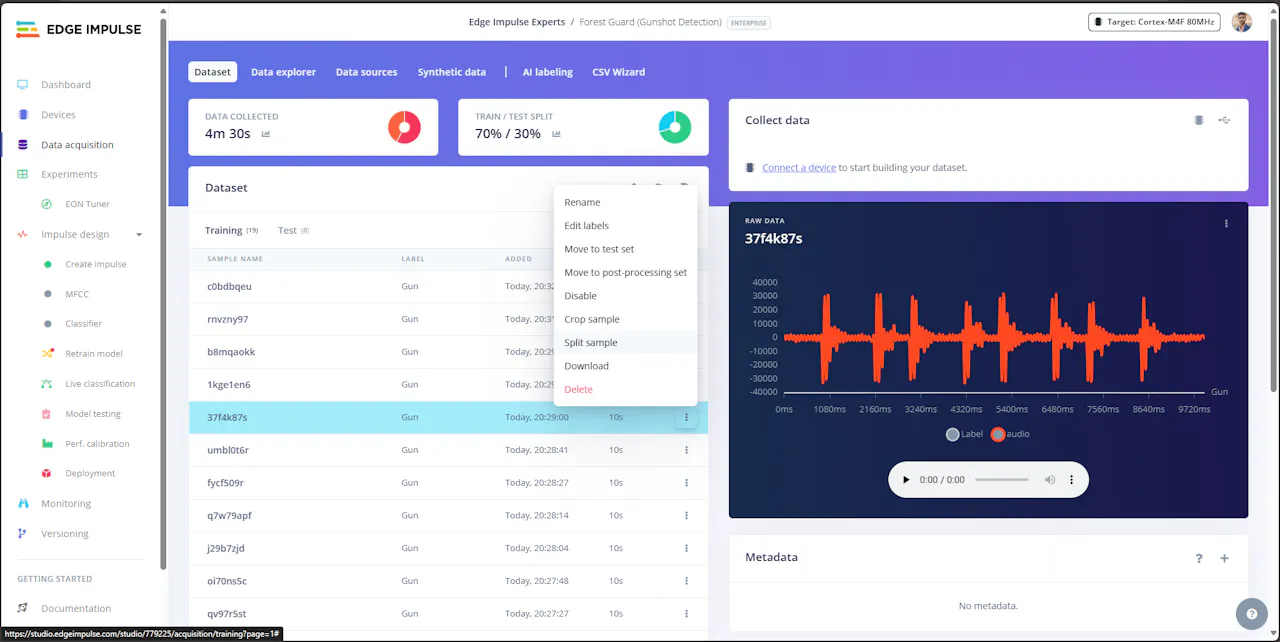
Once collected, the 10-second audio samples were split into one-second chunks with the Data Acquisition tool. After that, Sankhla designed an impulse, which defines how the data is processed, and the type of machine learning algorithm to use. In this case, the raw audio was first fed into an MFCC (Mel-Frequency Cepstral Coefficients) processing block. This step converts raw sound waves into spectrograms, essentially creating a fingerprint of the audio frequencies over time that a neural network can interpret.
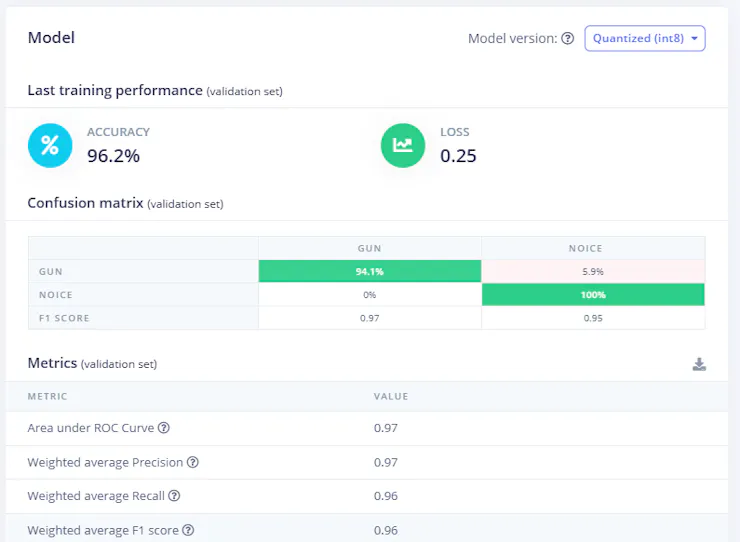
These audio fingerprints were then fed into a neural network classification block. During training, the model learned to distinguish the unique spectral signature of a gunshot from general environmental noise. The results were impressive: the trained model achieved better than 96% accuracy in distinguishing gunshots from background noise. Edge Impulse optimized the model heavily, resulting in an impulse with a tiny footprint that requires only about 12.5 KB of RAM and takes just 3 milliseconds to run an inference on the ESP32-S3.
I heard it through the digital grapevine
Finally, this trained impulse was exported as an Arduino library, which allowed it to be used as the base for a Forest Guard node's firmware. Now, when deployed in the forest, the node listens continuously. When it detects a sound matching the learned gunshot audio signature, it triggers an alert containing the event type and GPS coordinates.

This alert packet is handed to the RP2040 LoRa module, which broadcasts it into the mesh. The message hops from node to node until it reaches the gateway unit. The gateway, built around an Arduino Uno R4 WiFi and equipped with a LoRa radio and a TFT display screen, acts as the bridge to the outside world. When it receives an alert from the mesh, it uses its WiFi connection to sync the data to Google Firebase. Forest rangers or conservationists can then view these real-time alerts on a web-based dashboard, visualizing exactly where on a map a potential incident has occurred.
Sankhla’s project demonstrates that protecting vast, remote natural resources doesn't require massive infrastructure investment. With the right selection of hardware and software tools, just about anyone can get in on the action.
Whether it is poaching, illegal logging, or something entirely different that you want to keep tabs on, be sure to read Sankhla’s project write-up for all the details you need to get started.